
Mason started training with us in May 2024, a 13 year old basketball player weighing 84 pounds. Two years later he is 15, and the two numbers a basketball player cares about most have moved a long way.
His 10 yard sprint dropped from 1.86 to 1.65 seconds, 11% faster. His vertical jump climbed from 19.6 inches to a peak of 24.6. And his step to jump, the approach jump a player actually uses at the rim, went from 18.6 to 26.2 inches.
We are a golf performance facility, so a basketball case study might seem out of place. It is the opposite. It is the clearest proof we have that what we do is not a golf trick. Test the athlete, find the limiters, build the base, and the sport specific output follows, whatever the sport is.
Where He Started
At 13, Mason’s first testing session looked like most 13 year olds do. Vertical jump 19.6 inches, approach jump 18.6, a 1.86 second 10 yard sprint, and strength numbers with plenty of room: 12 pounds on the single arm press, 25 per hand on the split squat.
The plan was not complicated, and it was not basketball specific in the way people expect. No jump programs. No agility ladders. Progressive strength work, control of positions, medicine ball throws, and testing every few months to see what was moving.
And the dose was small. Mason trains with us one to two times per week, depending on the time of year. That is it. Two years of a modest, consistent dose beat what most kids get from programs promising more, faster.
The Plyometrics Question
Here is the part that will surprise basketball parents. We did very little plyometric work with Mason, and his jumps are the fastest rising numbers in his profile.
Plyometrics are the basketball version of golf’s speed training. They work, for athletes who are prepared for them. They are also among the most demanding things you can ask of a young body, because every rep is a high force landing that the tissue has to absorb. Right now a lot of kids are doing box jumps and depth jumps year round, chasing bounce, on bodies with no strength foundation underneath. That is the same top-heavy pyramid we wrote about with junior golfers: output training stacked on a base that was never built.
Mason’s jumps went up 20 to 41% with almost none of it. The strength was the plyometric program. When the legs can produce and absorb more force, the jump rises on its own, and the landings that basketball forces on him hundreds of times a week get safer at the same time.
The Jumps
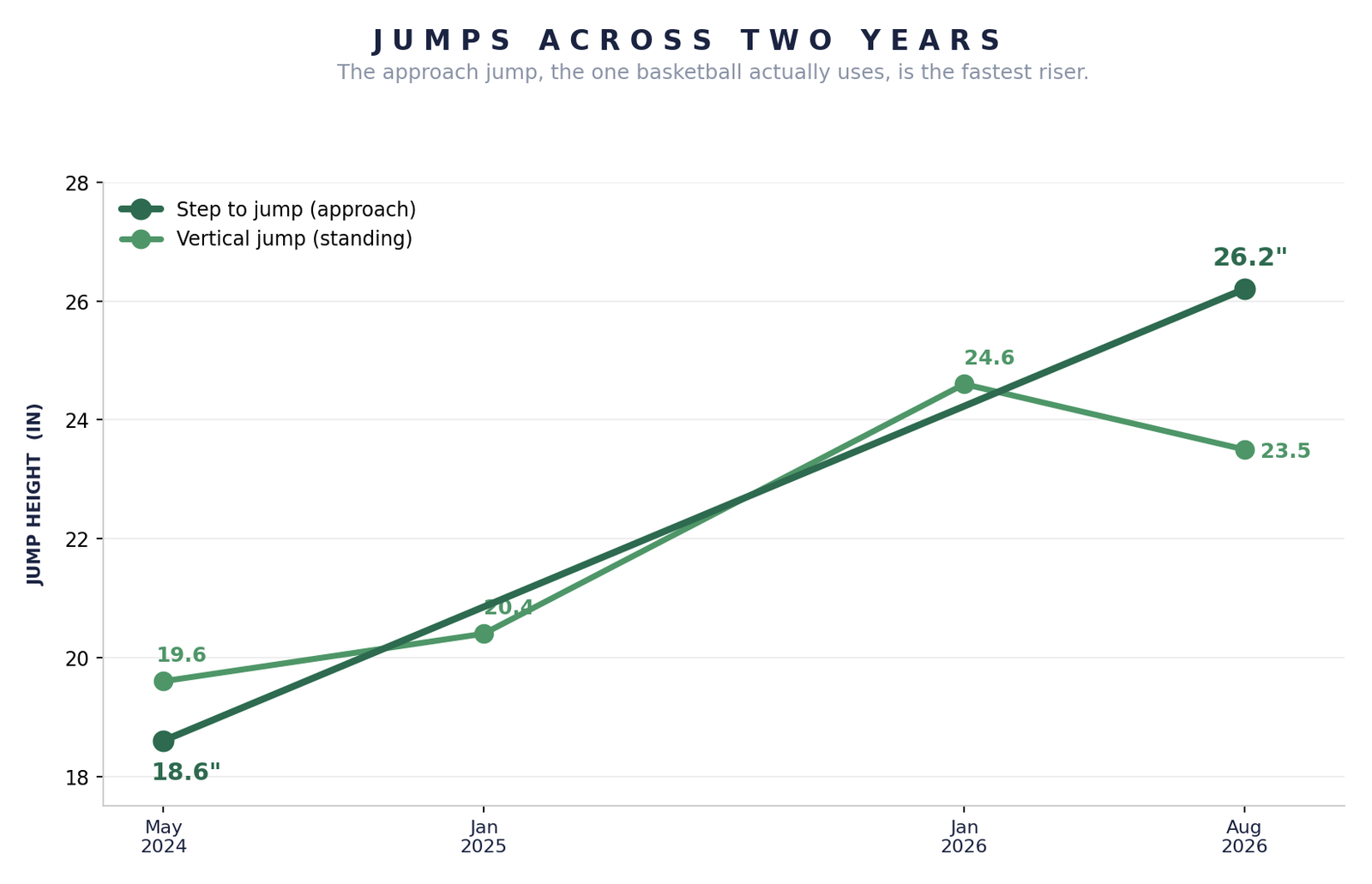
Look at which jump improved most. The standing vertical is up about 4 inches at his most recent test, 5 at his peak. The approach jump, where he steps into it the way a player actually attacks the rim, is up 7.6 inches, more than 40%.
That difference matters. An approach jump improving much faster than a standing jump means the athlete is getting better at absorbing and redirecting force on the move. That is exactly the quality basketball asks for on every drive, every rebound, every defensive slide. It is also exactly what strength training builds: the capacity to take force in and give it back.
Two Years in Ninety Seconds
The charts show the numbers. This shows the two years behind them, session by session.
The Sprint, and What Was Under It
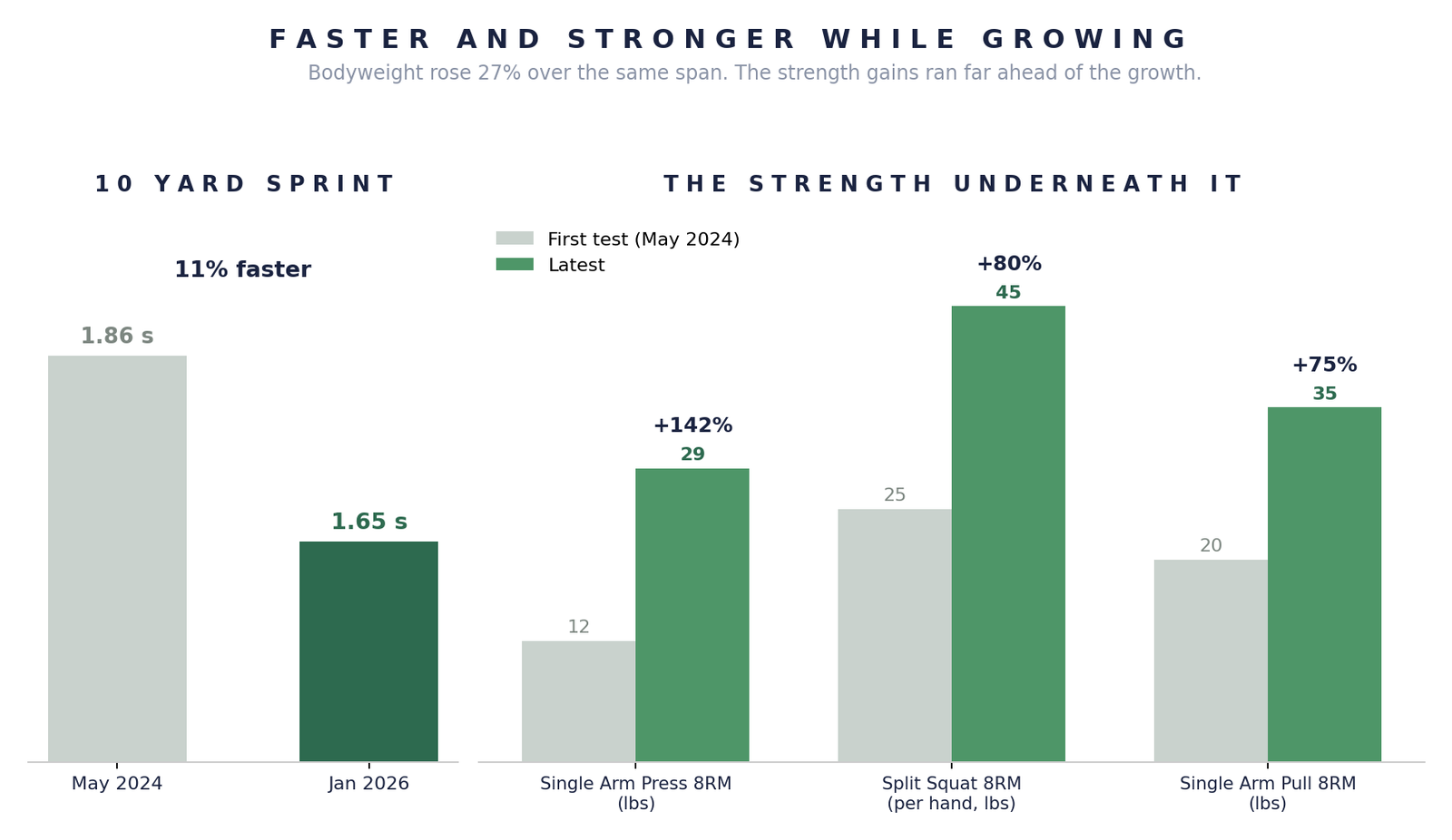
Same story as the jumps. We never ran sprint training blocks. The 10 yard time fell 11% because the force he can put into the ground roughly doubled. Sprinting is force production, and at this age, force production is the trainable piece.
We never trained the jump. We trained what the jump is made of.
The Growth Question
Mason grew a lot over these two years. His bodyweight went from 84 to 107 pounds, up 27%. So how much of this is just growing?
Here is the honest answer, and it is the reason we test. Growth adds mass, and mass alone does not make you springier or faster. It often does the opposite for a while, which is why so many kids get awkward mid growth spurt. What the testing shows is that Mason’s strength rose 75 to 142% while his bodyweight rose 27%. The gains ran far ahead of the growth. He is not just bigger. He is far stronger for his size than he was, and the jumps and sprint show where that went.
This is the same growth spurt window we wrote about in the junior athletes post, the one where untrained kids get stiff and clumsy and injury rates climb. Trained through it instead, the growth became fuel.
Same System, Different Sport
Put this case next to Max’s, the golfer who added 12 mph of clubhead speed while losing 47 pounds. On the surface they are opposites. Max got lighter. Mason got bigger. One swings a club, one attacks a rim.
Or next to Jack’s, the golfer who went the other way again and added 18 pounds to gain 14 mph.
Underneath they are the same case study. None of the three trained the output number. All three built strength and control, and the output number moved anyway. That is not a coincidence three times. That is how athletic development works.
What Comes Next for Mason
He is 15 and mid growth spurt, so the work continues: keep the strength compounding, convert it into upper body power where the throws have not caught up to the legs yet, and keep testing so the next two years are as measurable as the last two.
If you have a young athlete, in any sport, the takeaway is the one we keep repeating. Measure first. Build the base. Let the highlight reel numbers be the byproduct. Start with how we test, or read what parents should know.
Ready to train the whole system?
Book a free discovery call and find out what is actually holding your game back.
Get Started